
There is a particular kind of kitchen mess that appears immediately after washing dishes.
The dishes are clean.
The sink is clean.
But now there is a collection of wet plates, glasses and cups sitting beside the sink, and the countertop underneath them is slowly becoming wet too.
A dish rack solves part of the problem, but it also creates another one.
It takes up space.
For a large kitchen, that may not matter. For a small rented room, hostel kitchen, apartment or compact family kitchen, giving a permanent section of the counter to a drying rack can feel excessive.
That is where a dish drying mat in Nepal can make sense.
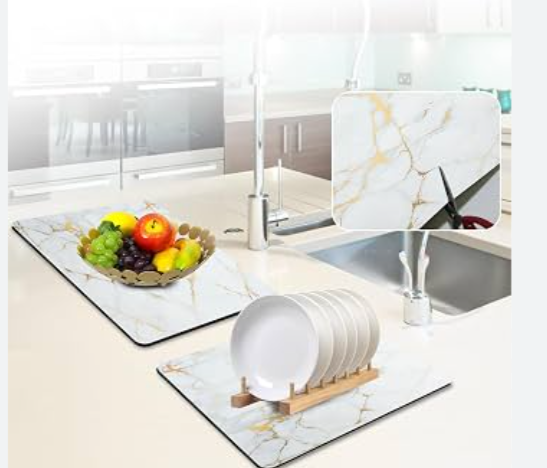
It is basically a soft, absorbent surface that gives wet dishes somewhere to sit while excess water is collected by the mat rather than immediately spreading across the countertop.
Nephot currently lists an Absorbent & Foldable Dish Drying Mat for Rs. 189. The product is described as absorbent, foldable, cushioned, quick-drying and reusable, with a non-slip backing.
The idea is simple.
And for the right kitchen, simple is exactly the point.
Why not just use a kitchen towel?
You can.
A clean kitchen towel underneath a few cups will catch some water and protect the counter.
The problem is that ordinary towels are not necessarily designed to become a temporary dish-drying surface.
A wet plate can soak through them. Multiple dishes can quickly make the towel damp. And if the towel stays wet for too long, you now have another thing that needs to be dried.
A dedicated drying mat is built around that specific job.
Nephot’s current model uses a high-absorbency microfiber composite fabric and has a cushioned surface intended to protect dishes and glassware while they dry.
That does not make a drying mat magical.
It simply gives the water a more appropriate place to go.
The biggest advantage is counter space
This is where a drying mat differs from a conventional dish rack.
A rack occupies physical space even when you are not actively using it.
A mat can be folded and put away.
That distinction matters in a small kitchen.
Imagine a counter that already has:
- a stove nearby
- a kettle or rice cooker
- cooking ingredients
- a cutting board
- soap and a sponge
- a few everyday utensils
Adding a permanent dish rack may leave very little usable workspace.
A foldable drying mat can come out after washing dishes, stay there while the dishes dry, and then be folded away.
Nephot specifically describes its mat as suitable for compact kitchens, apartments and dorm-style spaces, with storage in a drawer or cabinet when not in use.
That makes the product more about space management than dish drying alone.
It works particularly well for a few dishes
A drying mat is not necessarily intended to replace a large dish rack for a household washing an enormous pile of dishes at once.
It makes more sense when you have a relatively small batch.
A few plates.
Two or three glasses.
A couple of bowls.
Some utensils.
You wash them, put them on the mat, and leave the mat on the counter.
For one or two people, this can be enough for ordinary daily washing.
For a large family with a sink full of dishes after every meal, a proper rack may still provide more organized capacity.
That is why the useful question is not “Is a drying mat better than a rack?”
It is:
How many dishes do you actually need to dry at once?
The soft surface has another job
A wet glass placed directly on a hard countertop is not necessarily a disaster.
But glassware and ceramics are still easier to handle when they have a cushioned surface underneath them.
Nephot’s mat is described as having a soft cushioning layer designed to help protect glassware, ceramics and delicate cookware from scratches and chips.
It also gives small items a defined place to sit rather than having them scattered around the sink.
That can make the counter look less chaotic even when dishes are still drying.
What about water that the mat cannot absorb?
This is an important limitation.
An absorbent mat is not a drain.
If you put a large number of soaking-wet dishes onto a small mat, eventually there will be more water than the material can comfortably handle.
At that point, the mat itself becomes wet.
That is normal.
The solution is not to keep adding dishes indefinitely. Let the mat dry between uses, wring or clean it according to its care instructions, and avoid treating it as an unlimited water container.
Nephot’s product description specifically emphasizes quick drying and reduced moisture buildup, but that should be understood as a feature of the material, not a guarantee that the mat can absorb unlimited water.
Foldability is more useful than it sounds
“Foldable” can look like a throwaway feature in an online product listing.
For a drying mat, it actually changes how you use the product.
A traditional rack usually has to live somewhere.
A folded mat can live in a drawer, cabinet or another narrow storage space until you need it.
That is particularly useful for kitchens where the countertop doubles as preparation space.
You do not need to sacrifice that workspace permanently just because you occasionally need somewhere to dry dishes.
The same idea works in a rented room where kitchen storage is limited.
When you move, you also do not have to leave behind a bulky rack or figure out how to transport it.
Dish rack or drying mat?
Neither is automatically the right choice.
| Situation | Drying mat | Dish rack |
|---|---|---|
| Small kitchen | Very practical | Can consume more counter space |
| Few dishes at a time | Suitable | Works, but may be unnecessary |
| Large family dishwashing | Limited by surface area | Usually more capacity |
| Easy storage | Folds away | Usually stays assembled |
| Glasses and delicate dishes | Cushioned surface can help | Depends on rack design |
| Permanent drying station | Less suitable | More suitable |
| Temporary drying area | Very suitable | Less flexible |
A drying mat is basically a temporary drying zone.
A dish rack is more like a permanent drying station.
That distinction makes the choice much easier.
Small kitchens in Nepal can make this more useful
Kitchen size is not the same everywhere.
A large modern kitchen can comfortably accommodate a dish rack, drying area and preparation space.
But plenty of people are working with much tighter layouts.
A rented flat may have a narrow countertop.
A hostel room may have only a small cooking area.
An apartment kitchen may have enough room to cook but not enough spare counter space to keep another object permanently sitting there.
In those situations, something that disappears when you are finished using it can be more useful than something that is technically larger and more capable.
This is also why a drying mat fits naturally alongside other small-space kitchen solutions rather than competing directly with them.
How to keep a drying mat from becoming another source of mess
The mat itself needs care.
The easiest mistake is to leave it permanently wet under a pile of dishes.
After the dishes have dried, give the mat a chance to dry too.
Keep the area underneath it clean.
If food particles or other debris fall onto it, wash it rather than simply folding it and putting it away.
Nephot describes its model as reusable and easy to clean for everyday kitchen use.
That makes maintenance part of the product’s usefulness.
A drying mat that stays damp and dirty defeats the purpose of having a cleaner drying surface in the first place.
What should you look for in one?
There are only a few things worth paying attention to.
Absorbency
The whole point is to deal with water from freshly washed dishes, so the surface needs to handle moisture effectively.
Size
A mat that is too small becomes frustrating quickly.
At the same time, buying an enormous mat defeats some of the space-saving advantage.
Think about the number of dishes you normally wash at once.
Cushioning
If you regularly wash glasses, cups and ceramic dishes, a padded surface can be useful.
Non-slip backing
A mat that moves every time you put a plate down is irritating.
Nephot’s listed model includes a non-slip backing intended to keep the mat in place on the counter.
Storage
If space is the reason you are considering a mat in the first place, make sure it can actually be folded or stored conveniently.
What does the Nepal market look like?
Dish drying mats are not particularly expensive compared with many kitchen accessories.
Current Daraz listings in Nepal include several absorbent dish-drying mats, with examples around Rs. 199 to Rs. 499 and larger or differently designed options costing more.
Nephot’s current foldable model is listed at Rs. 189.
So this is not really a category where spending dramatically more automatically solves the problem.
Size, material, absorbency, cushioning and how easily the mat can be cleaned matter more than simply choosing the most expensive option.
When a drying mat probably isn’t enough
There are kitchens where a mat will simply be too small.
If several people are cooking and washing dishes throughout the day, you may need more drying capacity.
If you regularly wash large pots, pans and cooking equipment, a larger drying rack or another dedicated solution may be easier.
And if your countertop already has a drainage system that works well with a rack, replacing it just because a mat is more compact may not offer much benefit.
The mat is strongest when the problem is limited space, not when the problem is having a huge number of dishes.
A tiny kitchen upgrade that solves a very specific problem
A dish drying mat is not an exciting product.
There is no complicated technology.
And is no app.
There is nothing to charge.
It is simply a designated surface for wet dishes that can disappear when you are finished using it.
And that is exactly why it can be useful.
If your kitchen counter is already crowded, a permanent dish rack can feel like another object competing for space. A foldable mat gives you somewhere to put wet dishes without committing that counter space all day.
Nephot’s Home & Living collection has other compact household and kitchen products, but the drying mat is a good example of a product where the value comes from solving a very ordinary problem.
Sometimes the useful kitchen upgrade is not another appliance.
It is simply finding a better place for the water.